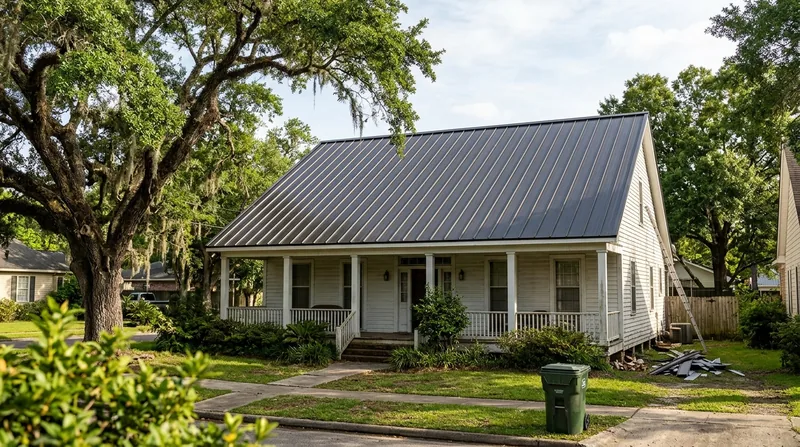




Standing Seam Metal Roofing in Lafayette: Built for Acadiana Heat, Wind, and Rain
Lafayette sits on the flat Vermilion River prairie, on heavy clay and bayou lowland about 30 miles from the Gulf, under live oaks, pecans, and crape myrtles that drop debris on roofs all year. Homes here run from 1850s Creole and Acadian cottages in the Saint Streets and Sterling Grove to 1920s Craftsman bungalows near Girard Park, 1950s brick ranches across Broadmoor, and newer subdivision homes along the Ambassador Caffery corridor and River Ranch. Standing Seam Metal Roofing in Lafayette is the concealed-fastener system we install most for homeowners who are done replacing shingles after every hurricane season. Panels are roll-formed to length, then mechanically seamed or snap-locked, so there are no exposed screws to back out as Louisiana heat flexes the roof every day. If you are comparing system types, start with our metal roof installation overview, then come back to this page for the standing seam specifics.
Why Standing Seam Makes Sense on Lafayette Roofs
Acadiana roofs take hurricane and tropical-storm wind, steamy humidity, salt-tinged air, intense UV, and torrential afternoon downpours, plus heavy oak and pecan debris. On a low-slope 1960s ranch in Broadmoor or a steep hipped Victorian in Freetown, exposed-fastener panels and shingles both fail at the same weak points: fasteners and seams. Standing seam moves the fasteners under the panel and raises the seam above the water path, which is why it holds up through the squalls that roll through Vermilion and St. Landry parishes every spring and summer.
- Concealed clips let the panel expand and contract with daily heat cycles without loosening a single fastener.
- Mechanically seamed panels carry strong wind-uplift ratings for hurricane season and tornado-season squalls.
- Cool reflective finishes cut attic heat load through long Lafayette summers and lower cooling demand.
- Panels shed oak leaves, pecan twigs, and crape myrtle bloom debris instead of trapping it like shingle granules.
- Roll-formed-to-length panels mean fewer end laps and fewer places for driving rain to find a way in.
For a house under live oaks in the Saint Streets, that combination of hidden fasteners and a smooth, debris-shedding surface is the difference between a roof you inspect twice a year and one you repair after every storm.
Key info: A Sterling Grove homeowner with a 1920s raised cottage replaced a patched tin roof with a 24-gauge standing seam system in a dark bronze finish. Two hurricane seasons later, the only maintenance was blowing off oak debris, with no fastener or seam issues.
Before you commit to a profile or color, check the current roofing permit rules with the Lafayette Consolidated Government, since thresholds and inspection requirements vary by jurisdiction and historic districts may restrict panel profile and color.
How We Install Standing Seam on a Lafayette Home
Every standing seam job starts with the deck, not the panel. On older Acadian cottages and Craftsman bungalows we often find soft sheathing, skipped underlayment, or old shingle layers that have to come off before anything goes down. We measure the roof, order panels cut to the longest run, and stage the coil so panels are not dragged across finished work. A typical Lafayette County install runs like this:
- We tear off the existing roof down to the deck and inspect sheathing for rot, especially on 1920s and 1940s homes near Girard Park.
- We replace damaged sheathing and install a high-temp synthetic underlayment rated for Louisiana heat.
- We set eave trim, valley metal, and penetration flashing before the first panel goes up.
- We roll-form panels to length on site, lift them without dragging, and fasten with concealed clips.
- We mechanically seam or snap-lock each panel, then install ridge caps, hip caps, and gable trim.
- We walk the roof, water-test the valleys and penetrations, and clean the gutters and yard before we leave.
On a recent Youngsville job along the Ambassador Caffery corridor, we ran panels 32 feet in one piece over a low-slope rear porch, which eliminated two end laps and a known leak point from the old shingle roof.
Key info: A Broussard homeowner with a 1990s brick home had three layers of shingles and a soft valley. We removed all layers, replaced the valley sheathing, and installed a standing seam roof with new valley metal, so the next downpour had nowhere to pool.
If your existing roof is still sound and you want to avoid a full tear-off, ask about our metal roof over shingles option, keeping in mind local code limits on the number of existing layers.
Standing Seam Approaches We Use Across Lafayette
Not every Lafayette roof wants the same panel. A steep Victorian in Freetown, a low-slope ranch in Broadmoor, and a new build in River Ranch each call for a different profile, seam type, and finish. Here is how the main approaches compare on Acadiana homes.
| Approach | Description | Best for |
|---|---|---|
| Mechanically seamed | Panels joined with a raised double-lock seam using a powered seamer. | Hurricane-zone homes and low-slope roofs needing maximum wind uplift. |
| Snap-lock | Panels snap together over a concealed clip with no mechanical seaming. | Standard-pitch residential roofs where speed and clean lines matter. |
| Standing seam over shingles | New subframe and panels installed over an existing shingle roof where code allows. | Sound single-layer roofs where the homeowner wants to avoid a full tear-off. |
| Standing seam with custom trim | Panels paired with custom valley, hip, and chimney flashing for complex roof lines. | Victorian, Queen Anne, and French Colonial homes with steep hipped and gabled roofs. |
We match the approach to the roof, not the other way around, so a Scott or Carencro home gets the panel that fits its pitch and wind exposure.
Standing Seam Metal Roofing Cost in Lafayette: What to Expect
Standing seam is the premium choice, and pricing reflects that. As a starting point, plan on From $10/sq ft for a standard-pitch residential installation, with most Lafayette homes landing in a range above that once you factor in tear-off, deck repair, and trim. Panel gauge, seam type, color finish, roof complexity, and how much old roofing has to come off all move the number. A simple gable ranch in Broadmoor prices differently from a steep hipped Victorian in the Saint Streets with three valleys and two chimneys.
- Roof pitch and complexity drive labor more than panel cost on steep or cut-up roofs.
- Tear-off of multiple shingle layers adds disposal and deck-inspection time.
- Deck repair on 1920s and 1940s homes is common once old shingles come off.
- Premium finishes and heavier gauges raise the per-square-foot figure.
- Chimney, skylight, and valley flashing add scope on complex roofs.
Getting two or three written estimates is smart in this market, because scope can vary widely between contractors. Compare what is being removed, what underlayment is specified, and whether flashing is included, then check our full pricing overview for a detailed breakdown.
What to Look for in a Standing Seam Metal Roofing Contractor Near Me in Lafayette
Hiring for standing seam is different from hiring for shingles, because the panels are cut to length and the seams are the roof. A contractor who mostly installs shingles may not own a seamer or have experience with concealed-clip layout. Start with licensed and insured status, ask for the certificate, and confirm the policy covers roofing work in Louisiana. Get at least two or three written estimates with the same scope so you can compare fairly.
- Ask for local references on standing seam jobs, not just shingle roofs.
- Confirm the contractor pulls the roofing permit and knows Lafayette Parish inspection requirements.
- Check whether historic district or HOA design review restricts panel profile and color before you order panels.
- Ask how they handle deck repair and what happens if soft sheathing is found.
- Verify the written estimate lists underlayment, flashing, and disposal, not just panels.
If you want to talk through your roof before you commit, reach out through our contact page and we will set up a free, no-obligation estimate.
Standing Seam Metal Roofing in Lafayette: Pricing Guide
| Service | Price | Details |
|---|---|---|
| Standard-pitch standing seam install | Starting at $10/sq ft | Includes tear-off, underlayment, panels, and standard trim on an accessible single-story roof. |
| Complex roof with valleys and chimneys | Starting at $14/sq ft | Covers custom valley, hip, and chimney flashing on steep or cut-up roof lines. |
| Standing seam over existing shingles | Starting at $11/sq ft | Subframe and panels over a sound single-layer roof where local code allows. |
| Large or multi-story home | On estimate | Scope and access need an on-site look before we give a firm number. |
| Travel | Included | In Lafayette and surrounding areas, no separate call-out or mileage fee. |
| Estimate | Free | Response within 24h at (337) 294-0108, no obligation to book. |
Indicative pricing, the exact cost depends on square footage, finish, and site access. Free personalized estimate within 24h at (337) 294-0108.


